Flit 1.5: transcribe a recording on your Mac

In short
Flit 1.5 adds a Transcribe tab that turns an audio or video file into a transcript on your Mac, with nothing uploaded. Drop a recording on the tab or on the Flit icon in the menu bar, or right-click it in Finder. The text appears as it goes, and a two-hour recording takes a few minutes. When it is done you can read what the voice model heard beside the formatted text, copy either, and export Markdown, SRT or VTT. It is a free update for every license, and it is on in the trial.
Transcribe your first recording
The Transcribe tab is in Settings, under Activity. It takes audio and video that macOS can play: MP3, M4A, WAV, AIFF, FLAC, MP4 and MOV among them. A video is read for its sound, and nothing is done with the picture.
- Right-click the Flit icon in the menu bar and choose Settings…, then Transcribe in the sidebar.
- Drop a recording on the tab, or click Choose File and pick one.
- The file is shown with its length. Click Transcribe.
- The text appears as each piece finishes. When it is done, click Copy.
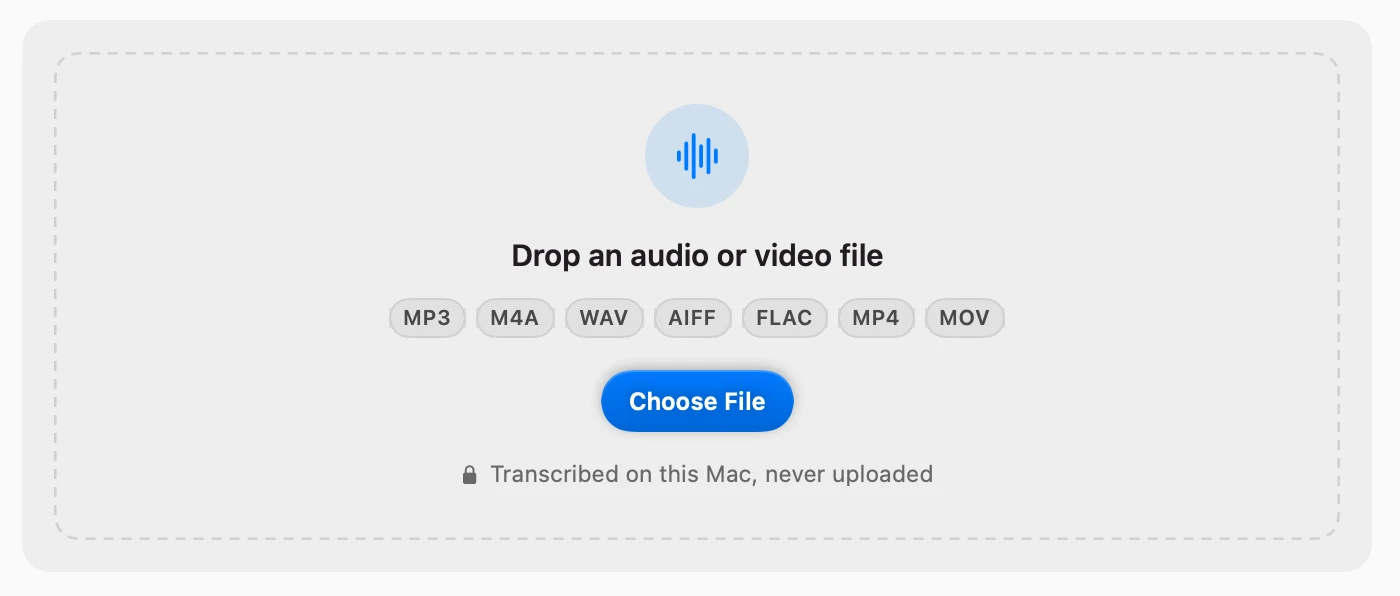
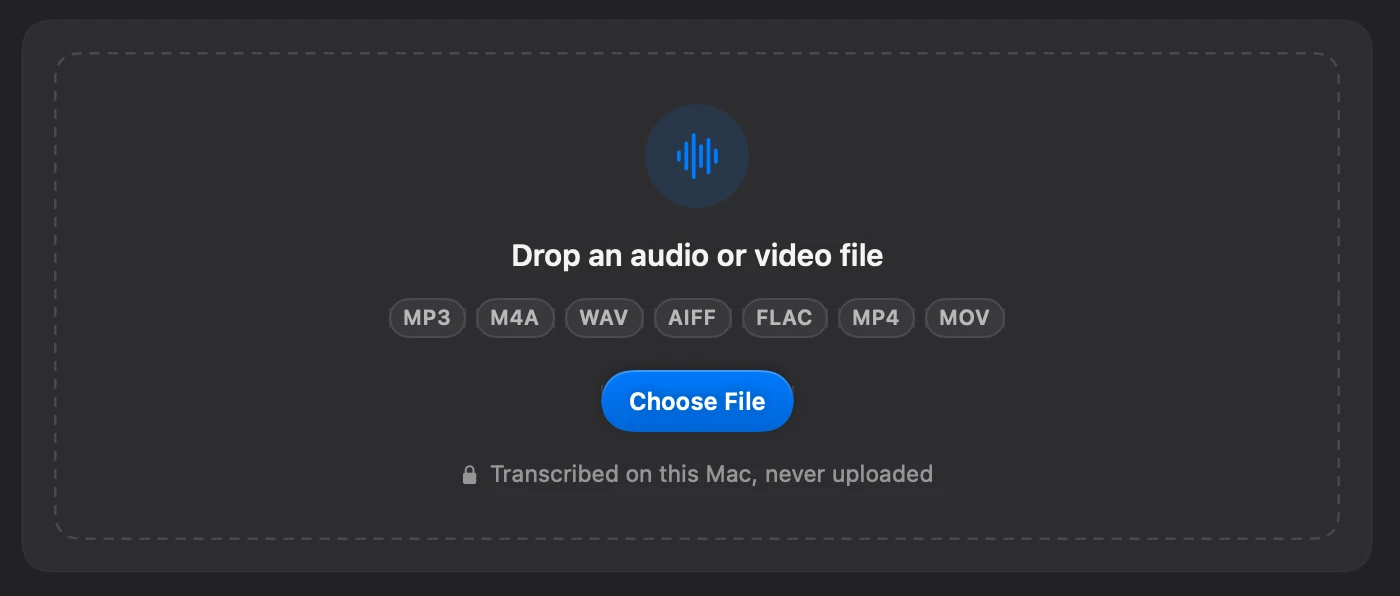
The first transcript uses the voice model you dictate with, so there is nothing more to download.
Four more ways to hand Flit a file
You do not have to open Settings first. Each of these opens the tab for you, so you can watch the text arrive.
- Drop it on the Flit icon in the menu bar. The job starts at once.
- Right-click the file in Finder and choose Services → Transcribe with Flit. The job starts at once.
- Open it with Flit: right-click the file, choose Open With, then Flit. The job starts at once.
- Right-click the Flit icon and choose Transcribe File…. A file picker comes up, and the tab opens with the file ready, so you can change the model or the formatting before you click Transcribe.
Select several recordings and they run one after another.
While it runs
The card shows how far into the recording Flit is and about how long is left, with the transcript so far under it. Stop ends the job. A file you add while one is running waits in line and starts by itself, and the card says which is next.
You can close Settings and keep working. The Flit icon in the menu bar wears a ring that fills as the job goes, and its menu shows the file name and the percentage. If Flit is in the background when the transcript is ready, a notification says so. Click it to open the transcript.
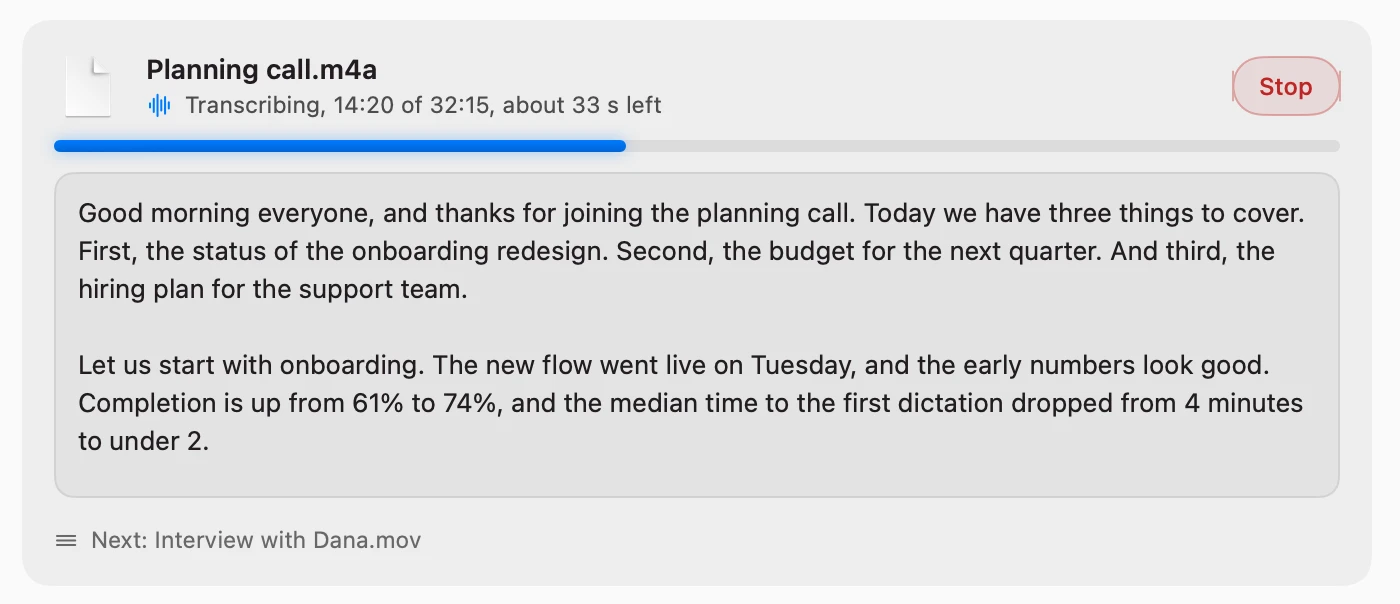
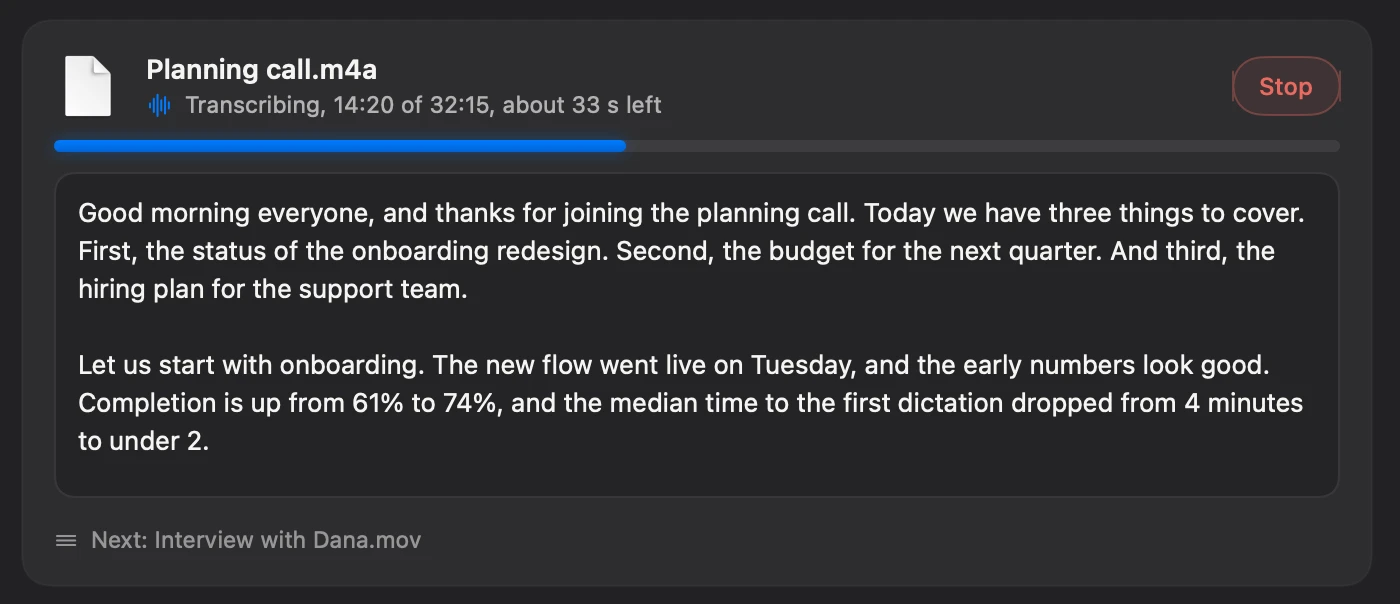
The first time a transcript finishes in the background, macOS asks whether Flit may send notifications.
Read it, copy it, export it
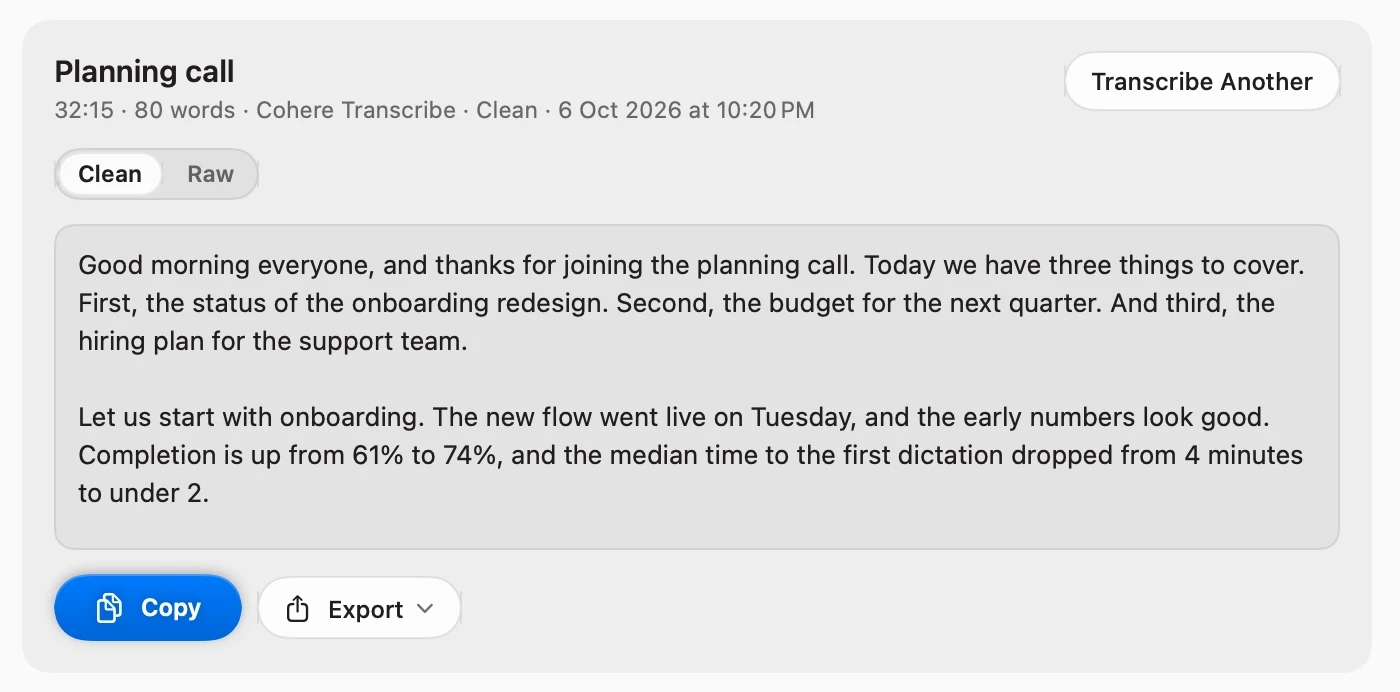
A finished transcript shows its length, word count, voice model and formatting level on top, and the text in paragraphs. A new paragraph starts where the speaker paused for two seconds or more.
- Copy puts the text on the clipboard.
- Export saves it as Text, Markdown, SRT subtitles or VTT subtitles. The subtitle files carry timestamps, one line per sentence.
- Show in Finder opens the folder with the text file Flit saved for you.
- Transcribe Another clears the card for the next recording. The transcript stays in the list below.
Raw or formatted: see what was heard
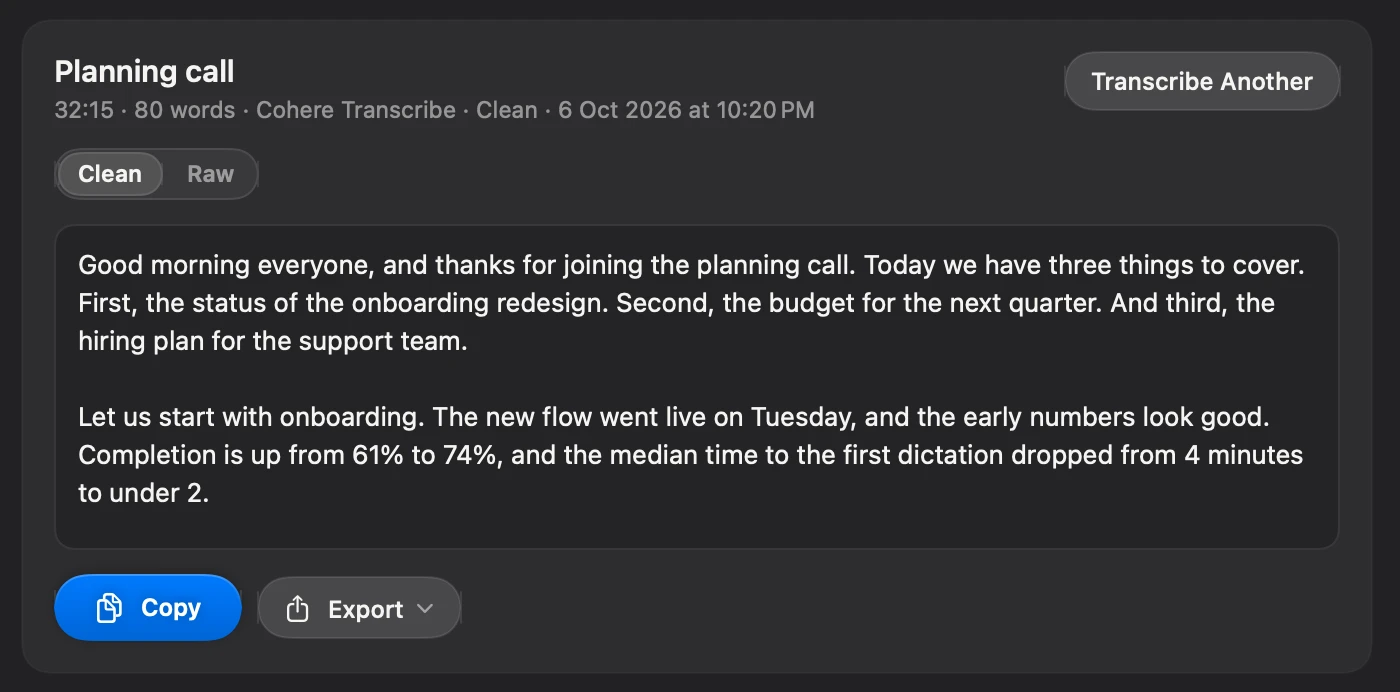
Under the title is a switch with two sides. The left side is the formatting level the transcript was made at, Clean or Polished. The right side is Raw: what the voice model heard, with every hesitation and false start left in.
Use it to check a sentence that reads oddly, or when you want the words exactly as spoken. Copy takes whichever side is showing. The saved text file and the exports stay the formatted transcript.
The switch is hidden when the two would read the same, as they do for a transcript made at Verbatim. Transcripts made before this update have no raw text to show.
Choose the model, the formatting and the folder
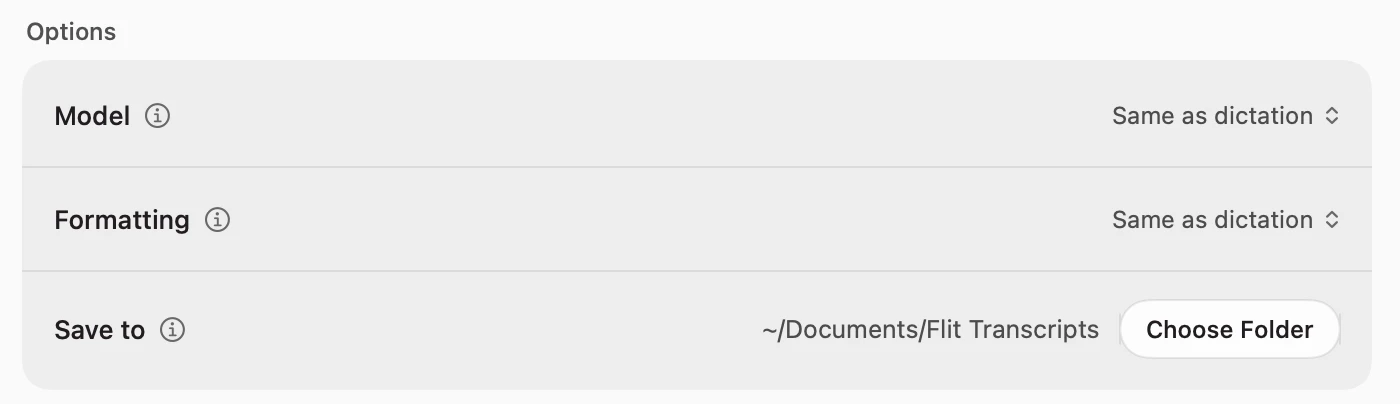
Three options sit under the card, and Flit remembers them. They are separate from your dictation settings, so you can dictate with a fast model and transcribe recordings with an accurate one.
- Model is the voice model for files. Only models you have already downloaded are listed. To add one, open Models in the sidebar.
- Formatting is how far Flit tidies the text. Verbatim keeps every word. Clean takes out the hesitations and writes times and numbers properly, with no wait. Polished runs the formatting model over every paragraph so the recording reads as prose.
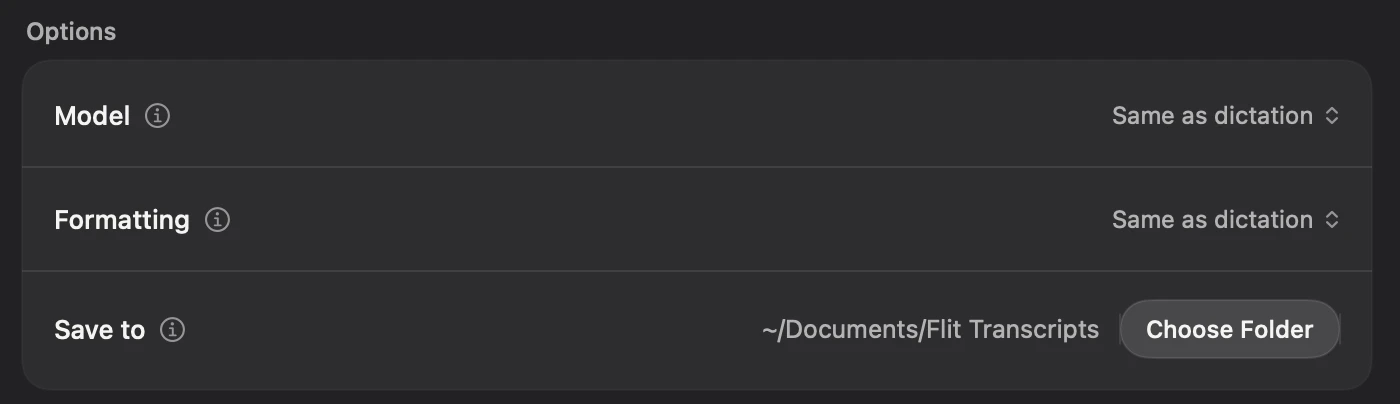
- Save to is the folder every finished transcript is written to as a text file. It starts as Documents → Flit Transcripts. Click Choose Folder to change it.
On an Apple silicon Mac with Cohere Transcribe, a two-hour recording took about three and a half minutes at Clean in our tests, and about fifteen at Polished.
Find a transcript later
Every transcript you make is kept under Transcripts at the bottom of the tab, newest first. Click one to open it again, with the same Copy, Export and raw switch. Once you have more than five, a search field appears above the list. It looks in the names and in the text.
The bin on a row deletes that transcript from Flit. The text file in your folder is yours and is left where it is.
The flit command, for Terminal
The same transcriber is a command, for a folder of recordings or a script. Install it once and flit works in every Terminal window.
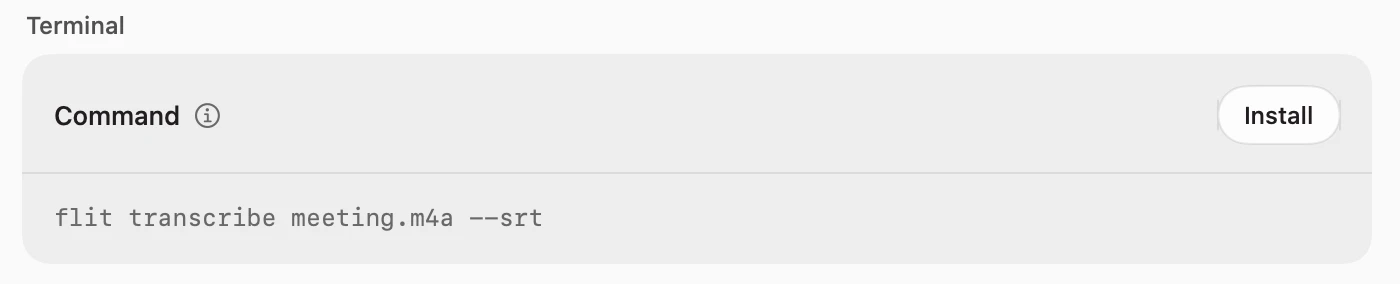
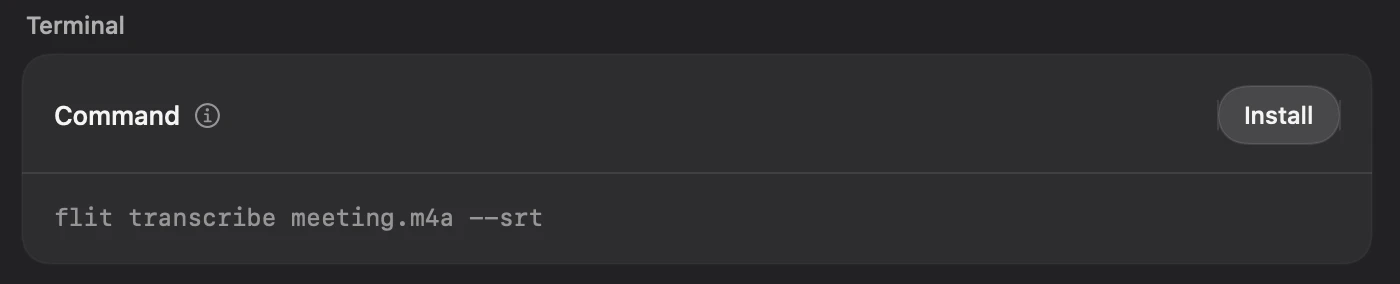
- Open Settings → Transcribe and find Command under Terminal.
- Click Install. On a Mac with Homebrew that is all. On a Mac without it, macOS asks for your password once.
- Open a new Terminal window and type the line shown under the button.
flit transcribe meeting.m4aflit transcribe meeting.m4a --formatting clean --out ~/Transcripts --srt- The transcript is printed, and the last line gives the speed and the word count.
--formattingtakesverbatim,cleanorpolished.--outnames a folder to write the transcript to as a text file.--srtand--vttwrite subtitles to that folder as well, and--mdwrites Markdown in place of the text file.--modeland--languagechoose the voice model and the language of the recording.flit helplists all of it, andflit versionsays which Flit the command belongs to.
If another tool on your Mac already answers to flit, as a Python packaging tool of that name does, nothing of yours is replaced: the command is installed as flit-app, and the row says so. Remove takes it away again. The command follows the app, so moving or updating Flit does not break it.
What it does not do yet
A transcript is one flow of text. Flit does not say who said what, and it does not record a meeting as it happens: you hand it a recording you already have. Both speaker labels and meeting recording are planned, and both will run on your Mac like everything else.
Questions people ask
Is Flit 1.5 a free update?
Yes. Every license includes twelve months of updates, and 1.5 is one of them. The trial has the Transcribe tab too.
How do I get it?
Right-click the Flit icon in the menu bar and choose Check for Updates…. The Transcribe tab is in Settings after the restart. Your settings, dictionary, snippets and history carry over.
Is the recording uploaded anywhere?
No. The file is read on your Mac by the same voice models that dictate, and nothing leaves the Mac. Flit transcribes with Wi-Fi off.
How long can a recording be?
There is no limit. The file is read five minutes at a time, so a two-hour recording uses about as much memory as a short one.
Which languages does it transcribe?
The ones your voice model covers: Parakeet V3 covers 25 European languages, Cohere Transcribe 14, Qwen3-ASR 30, and Whisper the most.
Why is there no Raw switch on my transcript?
Either it was made at Verbatim, where raw and formatted are the same text, or it was made before the switch arrived. Transcribe the file again and it is there.
Where are my transcripts kept?
Two places. A text file in the folder you chose, which starts as Documents → Flit Transcripts, and the list in the tab, which also keeps the timestamps for subtitles.
The flit command is not found. What now?
Open a new Terminal window, since a window that was already open does not see a new command. If the row in Settings says flit-app, type that instead: another tool already had the name flit.
Does it label speakers?
Not yet. If speaker labels are the job today, MacWhisper does them on the Mac.

Everything in 1.5.0
Flit 1.5 is a free update. Right-click the Flit icon in the menu bar and choose Check for Updates. New to Flit? It is free for 7 days with every feature on, then $19 once.
- New Transcribe a recording. A Transcribe tab in Settings takes an audio or video file (MP3, M4A, WAV, AIFF, FLAC, MP4, MOV) and turns it into a transcript on your Mac. The text appears as it goes, a two-hour recording takes a few minutes, and you can keep working while it runs.
- New Every way in. Drop a file on the Flit icon in the menu bar, choose Transcribe File from its menu, right-click a recording in Finder and pick Transcribe with Flit, or open the file with Flit. The tab opens to show progress, and the icon wears a ring while it works.
- New Copy, save, export. Every transcript is saved as a text file in a folder you choose and kept in the tab for later. Export it as Markdown, or as SRT and VTT subtitles with timestamps.
- New Raw beside formatted. A switch on the finished transcript shows what the voice model heard, every hesitation included, next to the formatted text. Copy takes whichever is showing.
- New Your choice of model and formatting. Pick a voice model and a formatting level for recordings that differ from your dictation settings, and Flit remembers them. Polished keeps a recording as prose, in its own paragraphs.
- New From the terminal. Install the flit command from Settings, Transcribe, and flit transcribe meeting.m4a prints the transcript in any Terminal window, with options for the model, language, formatting level, output folder and subtitle formats.
- Privacy Recordings are transcribed on your Mac by the same models that dictate. Nothing is uploaded, and the file is read in pieces so a long recording does not fill memory.
- Better A notification says when a transcript is ready if Flit is in the background. Click it to open the tab.